Online Chat App

I have recently come across an online chat feature which you can install on your website(s) and chat with visitors. It does not cost anything and is entirely free. The company that provides it make their money through additional services should you need them such as providing a chat agent for you. If you go for the basic package then it is an excellent way of “being their” virtually for your website visitors.

You don’t have to sit at your computer and wait, you just leave it running in the background, and if someone clicks on the button, then you will get an alert, and they can talk to you using a local instant messenger type interface.

At the time of writing (21/03/2020) I have been using it a couple of days and have installed it on 4 websites and been on two chats in that time.

There is a further way of using this, if you install the app on your smart phone or tablet, you can chat at any time.

Now, I know that this system could be quite intrusive, especially if there was only one person acting as a chat agent. However if you had multiple people, or volunteers on this system, then it could be quite a powerful tool enabling you to continue to provide advice, guidance and support online in these difficult times with Covid-19 prevalent at the moment, and social distancing in place.

How do I install this?

First you need to go to this website: https://tawk.to  and take out an account. All they need is an email address, a name and a password. For first time users they will also ask for a website address where you intend to install the other end of the solution. This is known as a “Property” in their language. You can be signed into more than one.

Somewhere in this process you need to acknowledge an email they will send to the email address you provided to them as a means of verifying you are the right person.  As you work through this check your mailbox for an email from them and acknowledge it. Mine came in quite late in the process. 

Login to your website and go to the Plugins option. Click on add new and search for Tawk.to  you will find there is more than one. The one you need looks a bit like this:
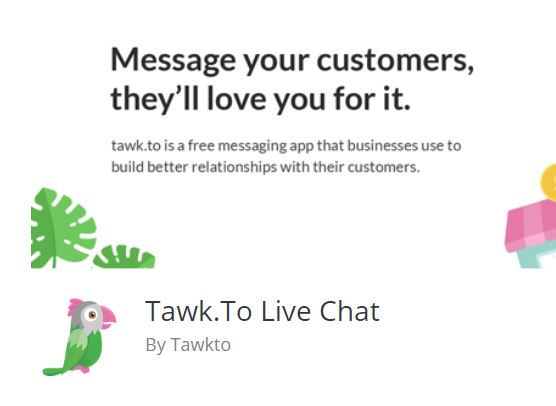
You can follow this link to find out about the plugin: https://en-gb.wordpress.org/plugins/tawkto-live-chat/ When you have located it in your plugins selection, install it. Then activate it. Once activated there is an option to access settings. All it needs to know is your account name and password. (Email address and password you used on the main Tawk.to website) and you will need to select the website you are using as well in a box for the settings.

Once enabled, switch your view so you are looking at the live website rather than the dashboard.  You will see there is a message in the bottom right of your website. If you are online and logged into the tawk.to website and have their dashboard running in another browser window, anyone visiting your site can chat to you.

Extending the service

Being dependent on one person is going to be a bit of a drag, and if it comes to that, they will disengage. From a practical standpoint, you can leave this running in the background on a computer (or smartphone / tablet) do something else, and only engage when there is someone to chat too. That may or may not be convenient.  However you could invite volunteers to be your chat agents. If there was a group of people, willing to be online as a pool of resources on your behalf, you are more likely to be successful with this system.

Anyway if you are even remotely interested, it is worth taking a look. With everyone socially isolating currently this would be a useful tool to continue a service remotely, even if it is at 15% of what you were doing before, that will be a huge help to those that have no help whatsoever, and are now feeling more isolated than ever.

Online 24 x 7

Not necessarily recommended for just one person, but it is possible to put the Tawk.to app on your smart phone or tablet and be logged in 24 x 7. So you do not need to be sitting in front of, or near a computer all of the time.

Interested but not sure what to do?

Drop me a line and I will get you set up on it.


Adding a document to a button

This article is mainly aimed at those people with Elegant Themes Divi based websites. This template has lots of features enabling you to build and maintain interesting interactive websites. With the prevalence of mobile devices representing more than 50% of the accesses to your website, you need to take more care with links. A finger is larger than a mouse cursor. Buttons can often get around this problem, they are easy and natural items to touch and therefore cause something to happen. 

Many of you have referral forms on your websites which are used by your clients. These change fairly regularly, so you need to reassign a new document to them, or add new buttons into your website. They are also used on policy pages to facilitate downloading policies. The page comprises an array of buttons in this case. 

Buttons are preferred to links

I have touched on buttons in the past, in all of the most recent websites (probably since late 2017) there are library elements built into your website which follow your colour schemes. This saves you from having to format the button when you add it to the website. 

The tutorial below tells you how to upload a document to your media library, how to add a button to your website and how to link the document in the library to the button. 

Click on the button below to download the tutorial. 

Using Data over the Mobile Phone Network

I visited a client in April that had moved to new offices, but did not have a broadband service provider connection over xDSL. They had been given a USB device which you fit a SIM into and use the cellular network data connection for their access to the internet.

This is increasingly becoming a popular alternative, particularly with PAYG deals such as GiffGaff where you do not need to have a long term contract in place.

Many of the new routers coming out have the facility to have a USB 3G/4G modem attached to provide either a second connection to the Internet for data sharing, or a standby facility if the local broadband fails.

However take care

If you are using one of these devices, do check to see if there is a firewall included in the device. If there is no firewall you could be opening up your entire network to persons unknown on the internet.

Continue reading Using Data over the Mobile Phone Network

Who is on my network?

Most of us have no idea who is on the network, and if they are on my network they must be legitimate right? Well no not necessarily. If you have a decent firewall between you and the internet, (a function usually incorporated into your broadband router) then computers generally cannot get into your network from the internet. There are exceptions of course such as remote access through the firewall which needs to be configured by someone.

I have spent much of the past month decorating and installing a new office, and reviewing my network(s)…. Yes I have more than one.

Sharing your network

At home I used to share my network with the family. That is to say in the conventional sense, we were all connected together behind the same router. So the router, with its built in firewall function provided protection from intruders from the internet.

However my son tends to cruise the internet and visit all sorts of websites of dubious content. He is way past the age of trying to apply any parental controls. If he happened to click on something (I stress if, there is no evidence it ever happened) he might install a local virus on his computer, which will open access through the firewall to a remote server. He also does a lot of gaming, and I did not want that getting in the way either.

Solution

I have several layers of network, an inner network which is tightly controlled, and an outer network which uses both wired and wireless systems in the conventional sense. Guests and anyone else that need general access can join the outer network and access email, the web and anything else they need. The wireless runs over 5GHz and 2.4GHz and uses WPA2 and PSK for encryption with complex passwords.

Inner network

While the outer network is protected from the internet using a router, there is a second router which connects the outer network to an inner network. The inner network has wired and wireless connections too at 2.4GHz and 5GHz, in this case a special configuration is used where only one SSID (Wifi Name) is used, and the router figures out which band to put them on based on the performance. It is all automatic and works quite well. But I also use another feature built into routers and WiFi which you may not be aware of.

Access Control Lists

There used to be a view when all networks were wired before WiFi came on the scene that if your premises were secure then nobody could get on to your network without your knowledge. That was because you had to be physically in the building in order to plug a cable into the network.

When WiFi came along you no longer needed to be in the building to join the network, you just needed to be within range. I once sat outside a block of flats in my car waiting for someone, out of curiosity and because I was bored I got out my iPhone and looked around to see what WiFi networks were around. I found one very near, I could establish which router it was (Netgear), found the default user name and password, and managed to log in! This was only possible because the owner never read the instructions and changed the default password. But it demonstrates it can happen. From here I could have done all sorts of things, but obviously did not.

WiFi routers have something called ACL’s or Access Control Lists. These allow you to enter the MAC (Media Access Control) Address into the router for each WiFi device on your network. Each networking device has a MAC Address, this is a sequence of hexadecimal characters usually written like this: 08:0E:05:21:DF:41 the first three sets of characters can be used to identify the manufacturer of the controller chip used in the device. They are usually but not always hardwired into a device. They are generally unique too. As in most things there are exceptions to this rule.

You set up your WiFi router to allow specific networking devices to connect to your WiFi providing their MAC address is in the list. If it is not in the list it cannot connect to the network even if the WiFi password and SSID is known. So in other words, you control who can access your network and resources on your network. A third party knowing the WiFi network and the password cannot connect to your network. It reports the password is wrong, even though it is isn’t.

Returning to who is on my network

There are tools you can use to discover who or what is on your network. These tools are well known in the Linux world if you play with computers a lot or come from a networking background. There are some programs out there that you can use to scan your network and list what is in the network.

Checkout the following if you have an iPhone: https://techet.net/netanalyzer written by Jiri Techet. If you are curious about your network and its performance, this is an incredibly useful tool. Plus it is portable, you can test any network with it.

The way it works is you connect your iPhone to the network you wish to scan, then run it. It will go through all of the IP addresses on the network to see if there are devices present. IP addresses are generally set by the router, it allows data to be sent to and from devices on your network, these are the equivalent to a postal address for a house.

For the £3 the application cost, it is brilliant and shows a list of everything that is connected. In my case on my inner network before I turned on ACL I found 12 devices ranging from TV’s, internet radio, printer, Ikea lighting controller, iPad, iPhones and other devices. But, it only shows you the MAC address of each device, you need to find out what it is.

I quickly established what most of them were, but then was stuck on the last one. It was eventually resolved to a BT Set Top Box attached to a TV.

The important point being that I now know precisely what is connected to my inner network, where it is located, and what it is doing. I can now add all of those MAC addresses into an Access Control List, and only those devices can connect to my network.

Going Deeper

It is also possible on the App to check on which ports are open on each device. If you imagine a device on your network is like a house, and the network is like the street your house is on, the ports are like doors into and out of your device. These can give you a clue about what it is and what it is doing. It may indicate something is communicating with something outside of your network. If that is the case it is important to know what it is.

WiFi Performance Test

The application can also check the performance from the smart phone over WiFi to a server on the internet to check the data performance. So you can check if there are dead spots anywhere, or areas where there are reduced performance. At my location from most areas in the house I can achieve over 60Mb/s download and 16Mb/s upload, so the WiFi performance is as good as my broadband performance. I am using advanced routers to do this that use 802.11ac WiFi.

Paranoia Prevails

So is this additional security worth the effort? I think it is, it provides some control over what can get into the inner network.

Is it foolproof?

If you are really paranoid, then it is conceivable in theory that an external monitor can monitor the network, and will over time figure out the password, even using WPA2 there are WiFi password cracking programs out there. Just do a search on Kali and WiFi, and you will find one. So this means no WPA2 network is really totally secure. If you have access to the MAC address in a hacking device, you can pretend you are a device in the Access Control List, so it is possible to get through these measures if you really know what you are doing.

However hackers generally look for soft targets and will go for those that are easier. So all I have achieved is mine is quite a bit more difficult to get into. There are other layers of security which are used to access and protect resources on the network such as passwords and accounts. Other monitoring will also quickly figure out if a duplicate MAC address or IP address is in use, which will also flag up a problem to the user.

If you are interested in looking at this further for your network get in touch in normal way.

Google Search Console

I have had a couple of enquiries about messages coming back from Google Search Console. Before I comment on these, what is Google Search Console? It is a website that is tied in with Google Searches and will confirm the most commonly used terms where it will place links to your website in the results of a Google Search.

If you are interested in how people find your website, this is a good place to look to understand it. However do bear in mind that it is only relevant for Google users, and not Bing and other search engines. So like most things where we may use Google tools to analyse usage, it is a good indicator, but I would not take it as gospel.

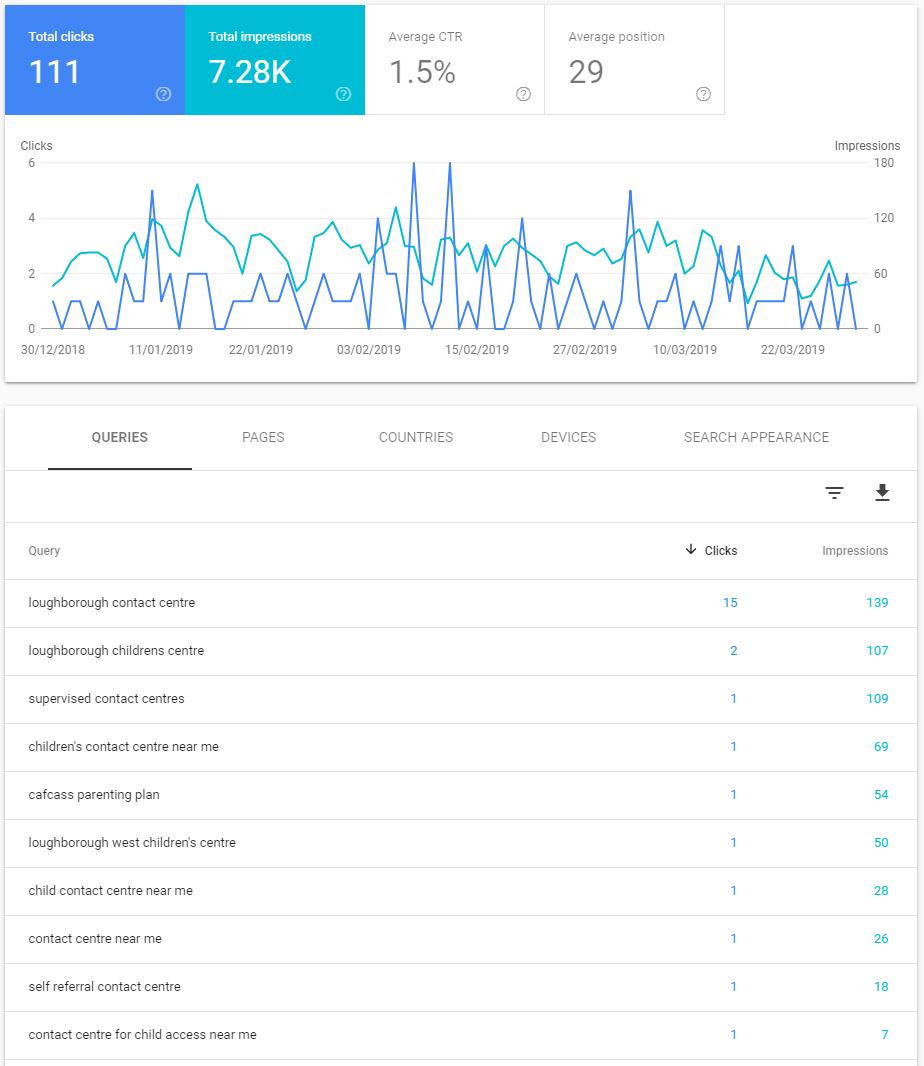
Take a look at the image below for Loughborough Child Contact Centre.

This shows some results over the past 3 months for this site, where it has listed the website in a Google Search results listing. You can see there are three parameters; query, clicks and impressions.

Google Search Console

Query: This is the search term entered by the user when they did a search for your website.

Clicks: This is how many times people entering that search term clicked on the link for your website.

Impressions: This is the number of times that Google has returned your website in a list of potential candidates for the query.

Continue reading Google Search Console

QR Codes

Marketing Tip

If you have an event coming up and there is an application form, or greater detail available online, you can use a QR Code which is a graphical symbol which a smart phone or tablet can scan, the scan function seems to be built into most smart phones. Just point your camera at one and it will automatically ask if you want to go to the website. You have probably seen them around, may even have scanned them in the past, but are not sure where to get them from.

I will quote this case, as it is a live example, of where having a QR code can be beneficial for you.

Home-Start Hampshire Charity Golf Day

Home-Start Hampshire are running a Charity Golf Day and asked me to add it to their website. Included in the package of information was a poster and two application forms, one in PDF format and one in MS Word format. (You need both because not everyone has MS Word).

I went to this website which you can create them for free: https://www.qrcode-monkey.com/ There are several QR code sites around, however as I found out some are after your money, so do take care, you can read what happened to me by skipping down this post to QR-CODE-GENERATOR.COM. I do however thoroughly recommend qrcode-monkey.com which is free to use, the codes do not expire, and there is no intermediate translation, and they can be used as many times as you wish.

I placed a wrapper around the QR code and produced the graphic below

Read more

Managing Images in WordPress

I frequently find that people have uploaded images from their phones and cameras directly into the image library and then added them to a page. What they have forgotten to do is optimise the image for the browser screen.

If I look at my camera, it takes image which are 5700px wide x 3800 px high and 10MB in size.

My monitor screen is a little higher definition than HD, so these images are too large for my browser, and if viewed on a phone which may be 700 pixels wide or less they are huge by comparison.

For most users these days, they view websites on mobile devices and may not be doing this over WiFi, so if they are downloading your web page from a 4G or 3G network, it is costing them money.

As a general guide your images need to be no bigger than 150kB in memory size, and no larger than the largest screen you are likely to come across. Today that is around 1200px for the web content space for most sites.  Many of the sites I have built, the content area is no wider than 1080px.  Continue reading Managing Images in WordPress

Even I get caught out sometimes

Just to show I share the same human traits as everyone else, even though I am fairly IT literate,  I thought I would share the following with you because it demonstrates that being cautious is often not enough.

IOS 11.0.3

My iPhone had been nagging me for some time about upgrading. I usually keep things up to date, and finally had some time and decided to go ahead with the update.  I have a MAC and backed up the iPhone into iTunes before proceeding, because I have been caught out before!

I have the usual range of weird stuff on my iPhone that gets played around with once or twice and then forgotten. But there are a handful of Apps I use all of the time, one of which is a password manager called FireBox.

I have had this for around eight years and it has always served me well. It was pretty basic, simple to use and not particularly glossy or elaborate. I keep or should say now; kept…. most of my critical passwords in there. For some years now I have not used the same password in multiple places unless it is for a simple login which represents no security threat if compromised.

I carried out the upgrade, and was presented with a message that some of the apps needed upgrading and to check in the Apps store, or contact the author. Wow, contact the author, that seemed like an odd request. Well it said contact the author, because the app was no longer supported by the new operating system.

There were only around 4 not supported, but one of them was FireBox. At this point panic starts to set in, but I did carry out a backup before I started, so I am covered…..

I start to research how to roll back the operating system. I find a way of doing it, download the old iOS, and before starting plugged my iPhone back into the computer. Here is where my problems started. On plugging my iPhone back into my computer, it backed it up again, and overwrote my previous backup. Only it is a different operating system now, and we have already established that FireBox is unsupported.

Bottom line, by the time I got the old operating system back on the iPhone I had nothing to restore other than a much older backup.

And the lesson of this sad tale

Don’t assume anything. I should have manually backed it up and stored the backup somewhere else.  The whole process cost me 2.5 days so far going around and restoring passwords from various places. My family tell me I worry too much about things, well this is one example where paying a little more attention would have been hugely beneficial.


How not to take a photograph

Images on websites can carry subtle messages, and can be used to help push the key messages to viewers. I recently received some images for inclusion in a site that were taken by an enthusiastic supporter of a charity. While there were quite a few images, the ones I felt I could use were only a very small proportion.

The main reason is that a poorly formed image can actually send the wrong message to visitors on your site. Unless the image is impactful and /or appropriate, I will generally not use it.

I have listed some tips and common pitfalls where your volunteers take images for you, or you try to use them on your website.

Focus

A blurred image, particularly that part of the image that should be very sharp will not look very professional on a website. Blurred images often occur because of camera shake rather than focusing on the wrong thing. Indoor images can suffer in this way because the shutter speed is very slow (less than 1/50th of a second). You can get around this by using a flash or by using a higher ISO setting. Panasonic compact cameras offer a feature called intelligent ISO that looks after this for you. Continue reading How not to take a photograph

Mobile Phone Bills

Have you issued mobile phones in your charity?

How much do you pay each month?

If you got here looking for free stuff, this is not free, but carries the potential for being a very low cost solution. 

GiffGaff is a well established mobile service provider, it is a largely self help business model created by 02. There is a large community of users/contributors offering support. So one assumes that the business model for GiffGaff is quite efficient if you outsource a lot of the support overhead to the community of users that use the service.

If you make a mobile call from a GiffGaff phone to another GiffGaff phone then the call is free. On this basis if you keep in touch with mobile volunteers then you could significantly reduce the cost of phones by having a mobile in the office to call those in the field.  Continue reading Mobile Phone Bills

Wingrove-Services
Privacy Overview

This website uses cookies so that we can provide you with the best user experience possible. Cookie information is stored in your browser and performs functions such as recognising you when you return to our website and helping our team to understand which sections of the website you find most interesting and useful.

You can adjust all of your cookie settings by navigating the tabs on the left hand side.

My privacy policy can be located here: Wingrove Media Privacy Policy (opens in a new window)

My Cookies Policy can be found here: Wingrove Media Cookies Policy (opens in a new window)