I received the following two unrelated emails and thought it would be worth highlighting the stupidity of one and the implications of the other. One is clearly a phishing example very poorly executed, a blind person could see this one is a scam, the second one illustrates people’s obsession with numbers of visitors. Let’s take a look at the United Nations and World Bank first.
The UN owes you some money
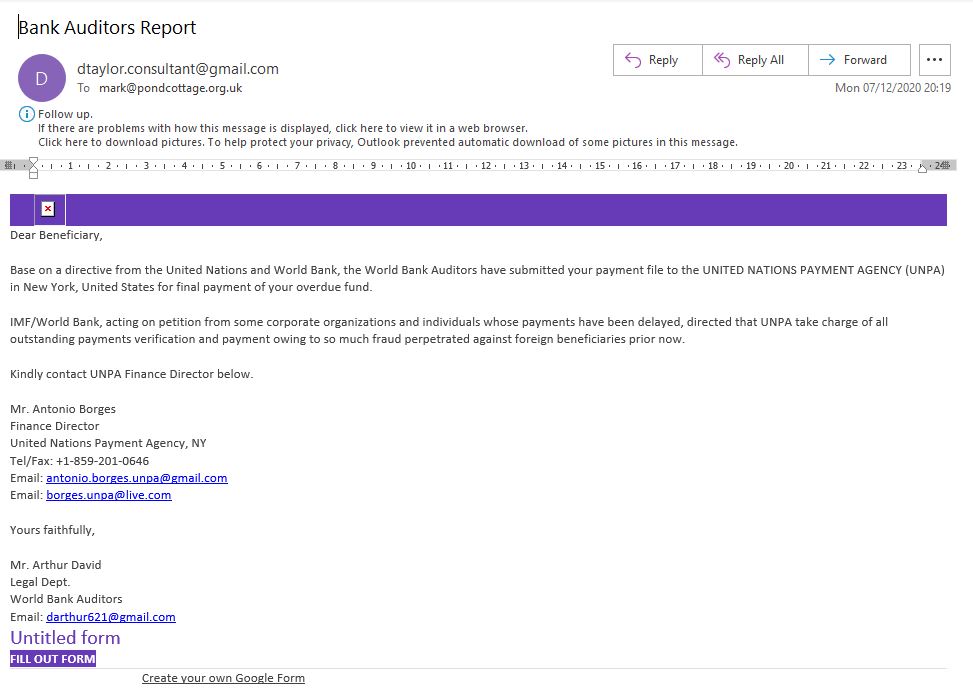
This is the really stupid phishing attempt. Here what jumped out at me within 3 seconds of opening it.
- Senders email address: “dtaylor.consultant@gmail.com” Would any self respecting “consultant” be using a gmail address?
- Would the Finance Director at the United Nations (Antonio Borges) be using a gmail address?
- Would the World Bank Auditor legal department representative Mr. Arthur David (darthur621@gmail.com) be using a gmail address?
- Better than all of that, the UN and World Bank need soemthing from me in a “Google Form”. They could not be bothered to try to hide form or dress it up as something official looking. The form is called “Untitled Form”.
So how does this work?
I am speculating here, as I would never click on anything like this, or even download the images associated with the email. The form will ask you to identify yourself, tell you it is going to send you some money and ask you for details about your bank. It may even offer a form that looks like a log in to your bank. Either way, whatever you add to the form is sent back to the scammers. Depending on how much detail you have provided, they may contact your bank and pretend to be you, or contact you, in the latter case there are all sorts of ways the scam can unfold.
My recommendation for anything like this, if it looks to good to be true, it probably is. Delete it, don’t be curious about it, don’t click on anything, or even download the missing images. Remove it from your system. The email is below. Click on the image to see a larger version of it.
Obsession with numbers
I tend to see the following a lot, it highlights a method of cooking the books for a website to give the appearance that it is more popular than it really is.
Firstly this message may get beyond spam filters. It has probably been entered by hand and not an automated message. So any spam detection in the form that picked this up will be defeated. It does not carry a lot of links either. What it is referring to is not strictly illegal, although it may distort the truth significantly.
Click on the image below to see a larger image.
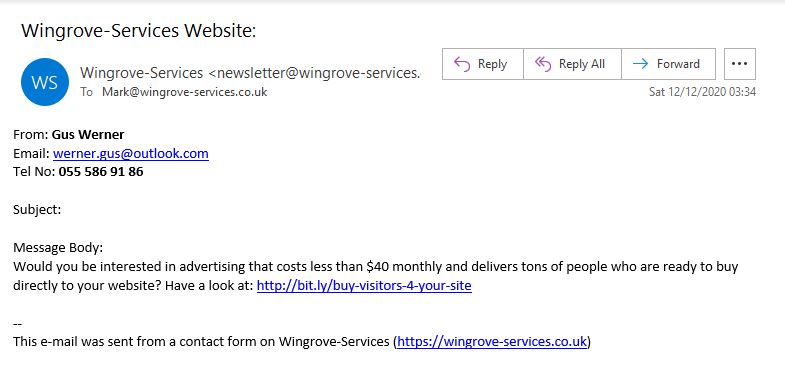
Should you “buy” visitors to your site?
I am intrigued with whom this is aimed at. A web developer will place a website online, and the client will expect visitors to flood to the site. In practice that does not happen. You also need to market the site through various channels to establish your value proposition, and get visitors to the site. You then have to maintain that level of interest.
However it occurred to me that either as the website developer, or perhaps the marketing manager behind the website, may be tempted to drive the numbers higher by paying for visitors to a site in order to meet some metric placed on them by the management of the organisation. What I do not understand though is more visitors does not mean more business, or greater engagement. In this case those visitors may be working from India or the Philippines, being paid $20US per day to visit lots of websites and generate traffic. Of course these people have no interest in your website or organisation. They also have no money to pay for products or services.
In some cases the apparent visitors are not actually real. It is manipulated by a computer running a script, or a network of computers which will visit a site and appear to come from another website. If you run Google Analytics on your site you can sometimes tell where someone came from.
I read a report a few years ago about Referral Spam. This can be detected in your Google Analytics reports where a visitor was on your website for 0 seconds. Practically speaking that visitor was unlikely to be human. It was a computer that visited your site, or perhaps never even visited your site but was able to fool another site that they came from your site.
I have multiple examples of websites that have been taken down, but I have not removed the google analytics token, and the site is still reporting visits! Which of course is not practically possible.
Why?
If site B receives a visit from site A, in some cases site B may pay a referral fee back to site A to acknowledge the lead or business. Fundraising sites like EasyFundraising.co.uk legitimately use this to raise funds for charities. But there are also scammers who use it, create traffic, and receive payments back for generating traffic. In the latter case, the traffic may not be real, and almost certainly will not be generating any interest or business in your website.
Bottom line is work hard on your website and your marketing, review your content regularly and get some fresh and interesting news on your site at least once a month. It is all work, there is no quick and easy answer which costs very little and will yield the same results.
The people who visit your site who say; “I have just visited your website, it could have a lot more visitors…….” have no idea how many visitors you have in the first place, so they cannot really comment on whether you could have more. At the end of the day it depends on whether you are a regional charity, national charity, what your value proposition is, how much effort are you placing in communicating with your visitors through your website, and more importantly through channels such as social media to drive traffic to your website. These are the factors for success.