Sometimes I see a spam message come into my email box which is really stupid. It is like attaching a warning banner to the message saying “I AM SPAM”.
Here is an example below, can you spot what is wrong with this message?
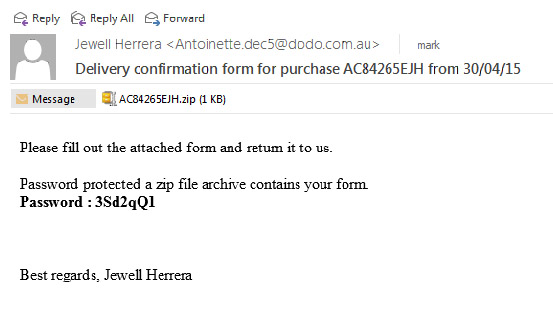
Here are two things that jump out at me. The email comes from “Jewell Herrera” but has been sent from the mail box “Antoinette.de5@dodo.com.au”. Why would you send a message from one person while pretending to be someone else?
A bigger mistake is telling someone that this is a password protected file AND putting the password in the same email. That makes no sense at all. Generally if you are sending a highly sensitive zip file, you would send the zip file password protected and then in a separate mail (possibly from another account you have) send the password. It is rather like leaving your house keys in your front door and saying “I am out by the way”.
Password protecting a zip file is also another way of hiding the contents. Anti Virus (AV) programs generally look for signatures in virus files. In this case the virus file is encrypted in the zip file, so an AV program cannot tell what is in there until it is opened.
Drilling down a little further, if you confirm a delivery for something, you sign for it when it arrives, not separately over the web. But look at the email address, is says dodo.com.au. That is from Australia. You would know if you had received something from Australia, and that is a very quick service. Dated the 30th of April, and I received it on the 1st of May!
So let’s check the email address and see if it is a real email address.

This simple test (mailtester.com) shows me that the senders domain name “dodo.com.au” is real, however there is no email address for that person on the server. So as I suspected it is spam.
NEVER OPEN ANY ZIP FILE SENT TO YOU FROM ANYONE YOU DO NOT KNOW OR TRUST
equally
IF YOU RECEIVE A ZIP FILE FROM SOMEONE YOU TRUST BUT THERE IS NO MESSAGE SAYING WHAT IT IS ABOUT. BE SUSPICIOUS. IT HAS PROBABLY BEEN SENT BY SOMEONE ELSE PRETENDING TO BE SOMEONE YOU KNOW
They very often contain self installing viruses and malware.
Just in case you have received a message and clicked on it, then nothing apparently happened; run a virus check on your computer using a good quality AV product. If you are using a free AV product, I would not rely on that, but generally you will find the major suppliers offer an online virus scanning service for one off events.